01 — Problem
Great outputs buried under bad UX
Many users want quick creative inspiration — for content, branding, side projects, or social media. But most AI tools are overloaded with complex interfaces and generic workflows that get in the way before any value is delivered.
Most AI tools require too much setup before users get anything useful. The core question was whether a lightweight AI utility focused on instant idea generation could improve activation and drive repeat usage through simplicity and minimal friction — with a fast "prompt → result" experience directly inside Telegram.
02 — Goals
Speed, activation, and economics
Product goals
- Reduce friction between idea request and AI output
- Test lightweight AI utility behavior at scale
- Optimize for fast first-session activation
- Validate Telegram Mini App UX for AI utilities
- Test monetization via Telegram Stars
Business goals
- Encourage repeat sessions and habit formation
- Convert free users into paid through friction-timed paywall
- Explore low-cost AI utility monetization models
- Validate AI microproduct economics
SEO / Content goals
- Build landing pages around intent-based keywords
- Target users searching for creative inspiration tools
- Create scalable SEO structure for future generators
03 — Research
Audience & competitor landscape
Target audience segments
Competitors reviewed
Key observations
- Many AI generators are overloaded with too many input fields
- Onboarding is overly complex before the first result
- Weak mobile UX — clearly designed desktop-first
- Generic outputs with no visible differentiation
- Poor paywall logic — interrupts at the wrong moment
Hypothesis
Users may prefer an ultra-lightweight AI experience where the result appears within seconds and no prompt engineering is required on their part.
04 — Positioning
Instant results, zero setup
Instant AI-powered idea generation for creators, founders, and marketers — directly inside Telegram.
- No signup or account required
- Instant results on first interaction
- Mobile-first interaction design
- Multiple idea categories in one place
- Frictionless, native monetization
05 — Landing Structure
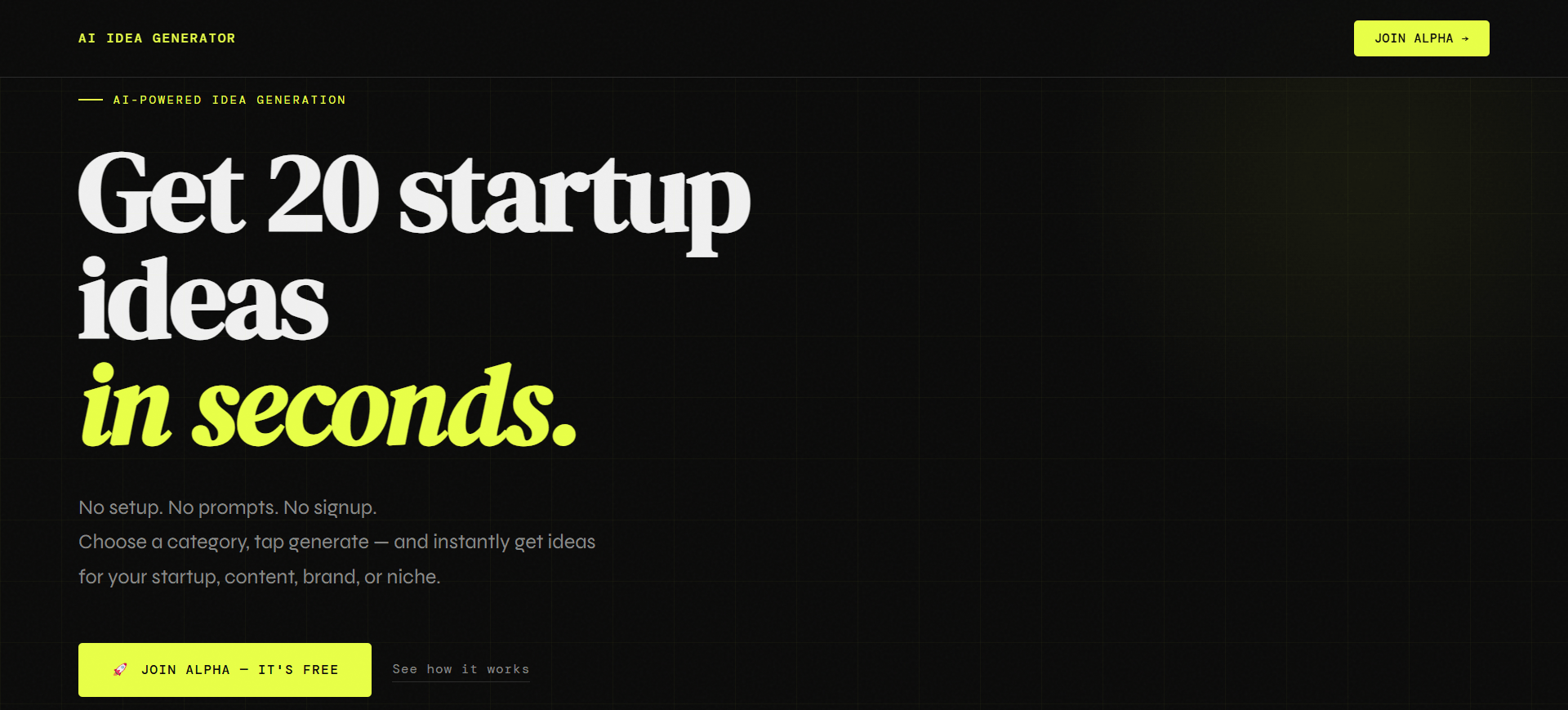
Built around the result, not the product
06 — Copy Decisions
Outcomes beat features
Tier-1 style: lead with what the user gets, not what the product does.
| Instead of | Better |
|---|---|
| AI-powered creative solution | Get startup ideas in seconds |
| Generate unique branding concepts | Need a brand name? Generate 20 options instantly |
UX logic behind the decisions
- Why Telegram: low friction; mobile-native launch; instant access; built-in payment infrastructure
- Why a short flow: the app was intentionally designed around minimal interaction — category → generate → result. Nothing else
- Why usage limits: encourage upgrades, control API costs, and create a natural retention loop around daily returns
07 — Monetization
Free enough to hook, Pro enough to convert
Why Telegram Stars
- Frictionless payment — no external checkout screen
- Mobile-native monetization that matches the platform behavior
- Enables impulse purchases at the exact moment of value delivery
08 — SEO Strategy
High-intent keywords, scalable structure
| Keyword | Intent |
|---|---|
| startup idea generator | Transactional |
| AI slogan generator | Commercial |
| business name generator AI | High Intent |
| nickname generator AI | Mass Traffic |
SEO architecture principles
- Separate landing pages per category for keyword precision
- Programmatic SEO potential for high-volume generator queries
- Category-based URL structure for topical authority
09 — Growth Potential
Built to scale beyond the first landing
10 — A/B Hypotheses
What we're testing
11 — Reflection
What this project taught me
Onboarding simplicity is the product. For AI utility tools, the speed from landing to first result is the core value proposition. Every extra step before the output is delivered is a lost user.
Outcomes outperform capabilities. Positioning around specific outcomes ("Get startup ideas") consistently performed better than generic "AI-powered" messaging — users respond to what they get, not what the technology does.
Paywall timing is a product decision. Showing the paywall at the right moment — after value is demonstrated, not before — is the difference between a conversion and a churn. This is a content and UX call, not just a business one.